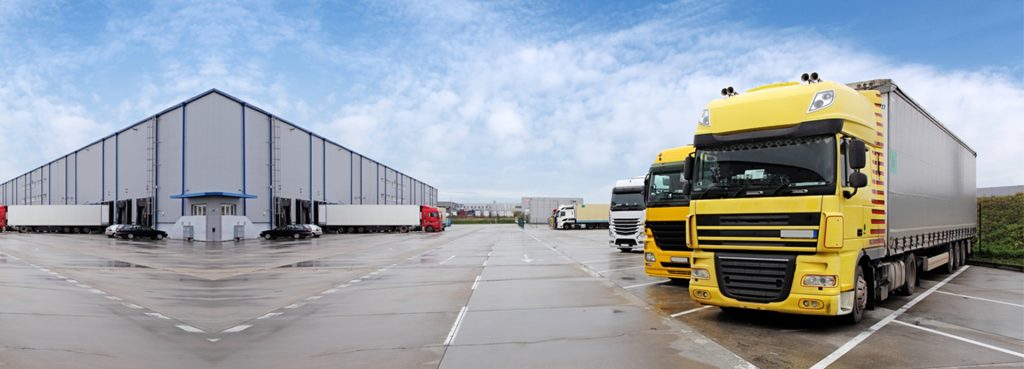
Warehouses and distribution centres concentrate enormous value in a single, often remote location: high-volume stock, loading equipment, HGVs and trailers. They also run to schedules that leave long windows of low occupancy (overnight, weekends, bank holidays), which is precisely when they are most exposed.
This guide sets out how warehouse security works in practice: where losses actually come from, which measures address them, and how to judge whether a provider is worth the contract.
Where warehouse losses actually come from
Operators tend to plan for the dramatic scenario, forced entry overnight, but losses in distribution environments come from several directions at once.
External theft
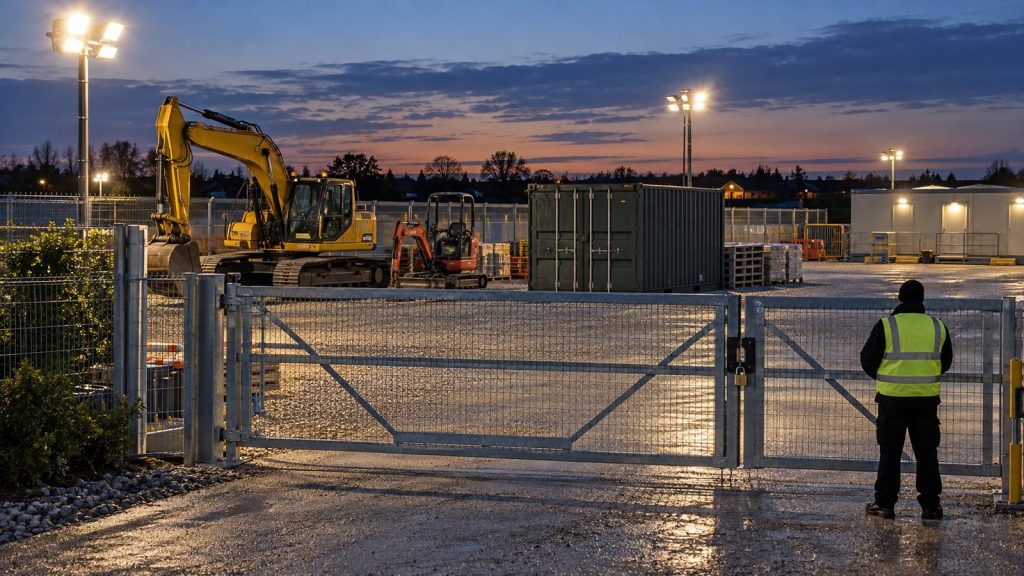
Perimeter breaches, trailer theft from yards, and targeting of high-value goods. Yards are frequently the weakest point: large, poorly lit, and often overlooked in favour of securing the building itself.
Internal shrinkage
Stock loss attributable to staff, agency workers or contractors. This is rarely addressed by physical security alone and usually needs a combination of access control, search policy and supervised loading.
Access control failures
Tailgating through goods-in doors, unlogged contractor visits, and drivers moving unescorted through operational areas. Most sites have a policy; far fewer have anyone enforcing it at the door.
Fire and safety incidents
Racking fires spread quickly, and a warehouse at night may have nobody on site to raise the alarm. Fire risk is a security concern as much as a compliance one.
The core components of a warehouse security programme
Manned guarding
An SIA-licensed officer on site provides what no camera can: judgement, and the ability to intervene. For warehouses, the value concentrates at goods-in and goods-out, where an officer can verify drivers, check paperwork against loads, and control who moves where.
Static guarding to BS 7499, the British Standard for static site guarding, sets expectations for vetting, training, supervision and record-keeping.
Gatehouse and vehicle control
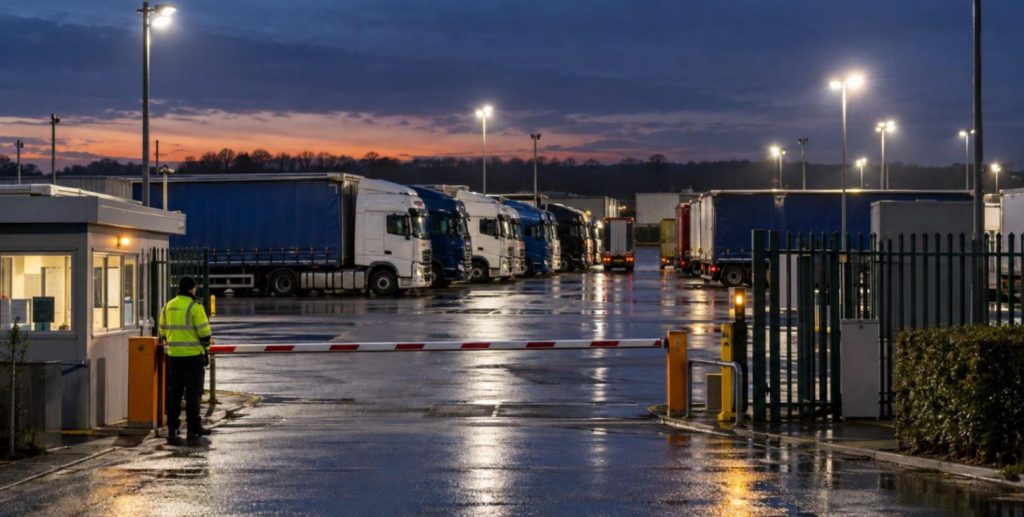
Every vehicle entering or leaving should be logged, with driver identity and load checked against the booking. A staffed gatehouse is often the highest-return measure on a distribution site, because it addresses external theft and internal shrinkage at the same chokepoint.
Mobile patrols and lock/unlock
For sites that cannot justify a permanent presence, scheduled patrols at irregular intervals provide deterrence at lower cost. Lock and unlock services also remove the risk of a manager attending an alarm activation alone.
Security dog units
Handler-and-dog teams cover large yards far more efficiently than an officer on foot, and the deterrent effect on open ground is difficult to replicate. Handlers should be NASDU-qualified, with the dog licensed and the team insured.
CCTV and monitoring
Cameras are evidential and investigative rather than preventative. They work when someone is watching and able to respond; they are considerably less useful reviewed after the fact.
Fire marshal cover
During shutdowns, hot works or high-risk periods, trained fire marshals maintain evacuation readiness when normal supervision is absent.
How to assess a warehouse security provider
Ask for the following, and treat vagueness as an answer in itself.
- SIA licensing. Every deployed officer must hold a valid, in-date SIA licence. Ask how licence expiry is tracked.
- BS 7499 certification for static guarding, and BS 7858 screening for personnel vetting.
- Accreditations. CHAS, SafeContractor and ISO 9001 indicate audited health, safety and quality management rather than self-declared standards.
- Supervision model. Who checks the officer is awake, on post and completing patrols? Unsupervised night cover is where most contracts quietly fail.
- Reporting. You should receive incident logs, patrol records and vehicle movement data, not just an invoice.
- Cover arrangements. What happens when the regular officer is ill? Ad-hoc cover with no site knowledge is a common failure point.
- Insurance. Confirm public and employers’ liability levels in writing.
Matching cover to your operation
There is no standard warehouse security package, because sites differ enormously in size, stock value, shift pattern and yard layout. In broad terms:
- 24/7 static cover suits high-value stock, continuous operations, or sites with a history of incidents.
- Night and weekend cover suits standard-hours operations where the building is empty outside shifts.
- Gatehouse-only cover suits sites where the concern is vehicle and load control rather than intrusion.
- Mobile patrol suits smaller units, or several sites within one geography.
A proper survey should precede any quote. A provider pricing a warehouse contract without walking the site is guessing.
Frequently asked questions
How much does warehouse security cost in the UK?
Cost depends on hours covered, number of officers, site risk and whether specialist resource such as dog units is required. Rates are quoted per officer hour, and any provider quoting before surveying the site is estimating rather than pricing.
Do warehouse security guards need an SIA licence?
Yes. Officers carrying out licensable guarding activity must hold a valid SIA licence, and it is the buyer’s responsibility to satisfy themselves that deployed staff are licensed.
Are security dogs suitable for warehouse sites?
They are particularly effective on large external yards and perimeters. Handlers should hold NASDU qualifications and the team should be insured for the deployment.
Can security guards also act as fire marshals?
Officers can be trained as fire marshals, which is often efficient for sites needing both. Confirm the training is current and documented.
What is the difference between static guarding and mobile patrol?
Static guarding places an officer on site for a defined shift. Mobile patrol visits at intervals. Static offers continuous deterrence and immediate response; mobile offers lower cost and broader coverage.
Warehouse security from First Class Services Group
First Class Services Group provides SIA-licensed warehouse security across the UK, including security services in London. We hold CHAS accreditation, ISO 9001 certification and BS 7499 certification for static site guarding.
Related services include security guards, gate security, security dog units and fire marshals. For manufacturing environments, see our industrial security services.
Request a site survey and quote, or call 020 7183 5811 to discuss your requirements.