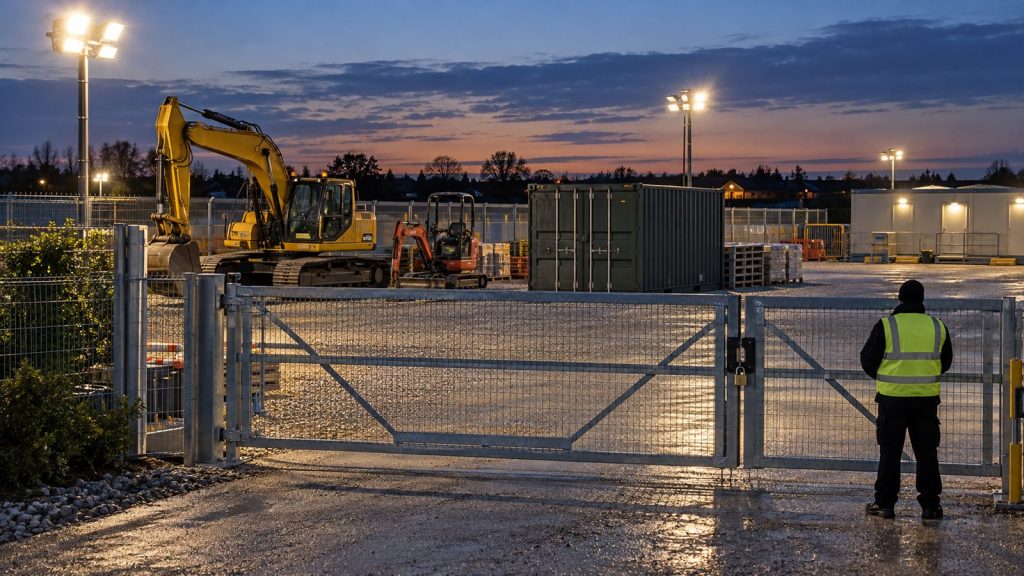

A static security guard is a licensed security officer who stays at one site for the whole shift, rather than visiting several sites on a patrol route. Their job is to protect the site, the people on it and its property by controlling who comes in and out, watching for problems, carrying out patrols of the site itself, recording what happens and responding to incidents and emergencies.
This guide covers what static security guard duties look like in practice, how they change from an office to a building site or a warehouse gatehouse, what a guard is and is not allowed to do under UK law, the SIA licence and training they need, typical shift patterns and what a static guard costs. It is written for businesses hiring security, with a short section for anyone thinking of working as a static guard.

What is static guarding?
Static guarding (sometimes called manned guarding or on-site security) means one or more security officers are posted at a fixed location for an agreed period. The guard might sit at a reception desk, staff a gatehouse barrier, walk the perimeter of a construction site at night or cover a warehouse over the weekend.
The difference between static and mobile security is simple. A static guard is on your site for the whole shift. A mobile patrol officer drives between several sites and spends a short time at each. Static guarding is the right choice when you need someone present all the time: to control access, deal with visitors and deliveries, or protect high-value stock, plant or an empty building.
What is a static post in security?
A static post is a fixed position on a site where a security officer is assigned for their shift, such as a reception desk, a gatehouse, a loading bay or a site entrance. The officer stays at that post, or patrols out from it and returns, and follows the assignment instructions written for that post. A large site may have several static posts, each with its own duties, for example one officer on the front desk and another on the vehicle gate.
Core static security guard duties
Every site is different, but most static guards carry out these core duties:
- Access control. Checking people and vehicles in and out, signing in visitors and contractors, issuing passes and making sure only authorised people get in.
- Site patrols. Walking the site on a planned route to check doors, windows, fences, gates, plant and stock, and looking for signs of intrusion, damage, fire or hazards.
- Deterrence. A visible, uniformed officer is one of the most effective ways to put off opportunist theft and trespass.
- Reporting and record keeping. Logging patrols, visitors, deliveries, keys and incidents in the daily occurrence book or electronic log.
- Responding to incidents. Dealing with suspicious behaviour, intruders, accidents or damage, and calling the police or emergency services when needed.
- Emergencies. Raising the alarm, helping with evacuation, meeting the fire and rescue service and acting as first responder until help arrives.
- Customer service. Greeting visitors, giving directions and being the first point of contact for staff and contractors.
- Opening and locking up. Unlocking at the start of the day, then securing buildings, gates and compounds at the end.
Static guard duties by type of site
The core duties stay the same, but the emphasis changes a lot from one site to another:
| Site | Main static guard duties |
|---|---|
| Office and commercial building | Reception desk, visitor sign-in and passes, contractor checks, post and deliveries, lock-up, first response to alarms and emergencies |
| Construction site | Gate control, vehicle and delivery logs, checking plant and materials, perimeter walks, out-of-hours cover, checks after hot works |
| Warehouse and distribution centre | Gatehouse, lorry arrivals and departures, trailer seal checks, yard patrols, loading bay doors, staff exit procedures |
| Gatehouse and industrial site | Barrier and access control, permit-to-work checks, visitor inductions, key register, roll call in an emergency |
| Retail | Visible deterrence, customer service, preventing theft within legal powers, incident reports |
| Residential block | Front-of-house access control, parcel logs, contractor supervision, emergency response |
You can read more about specific settings on our pages for office and building security, construction site security, warehouse security and gatehouse security.
What a typical 12-hour shift looks like
Here is an example day shift for a static guard at a mixed-use commercial site. Real timings are set in the site’s assignment instructions.
| Time | Activity |
|---|---|
| 06:45 | Handover from the night officer, read the occurrence book, check keys and radios |
| 07:00 | Open up, check the perimeter and car park |
| 07:30 to 09:30 | Busiest access period: staff, contractors and deliveries |
| 10:00 | Internal and external patrol, check fire exits are clear |
| 12:00 | Break, with cover arranged so the post is never left empty |
| Afternoon | Visitors, contractor sign-outs, deliveries and a further patrol |
| 17:00 to 18:00 | Staff leaving, lock-up checks on doors, windows and gates |
| 18:45 | Write up the log and brief the incoming night officer |
The paperwork behind good static guarding
Professional static guarding runs on clear written instructions and records. The British Standard for static guarding, BS 7499, sets out what buyers should expect, including:
- Assignment instructions: a site-specific document covering the site layout, duties, hours, patrol routes, access control rules, emergency procedures, who to contact and when. Permanent changes should be agreed with the client in writing.
- A daily register or occurrence book: every incident, occurrence and action taken is recorded with the time and date.
- Incident and accident reports for anything that needs follow-up.
- Visitor, key and vehicle registers.
- Formal handovers between shifts, including key control.
- Regular supervisory and welfare visits from the security company to check standards and support the officer.
FCS Group holds BS 7499 and BS 10800 certification, the British Standards for static guarding and for the provision of security services.
What a security guard can and cannot do
This is one of the most misunderstood parts of the job. In England and Wales, a security guard has no special police powers. They have the same legal powers as any other member of the public, plus whatever authority the site owner gives them to control their own property.
What a static guard can do
- Refuse entry to anyone who does not meet the site’s conditions, and ask people to leave private property on the owner’s behalf.
- Search people or bags with their consent, for example where a search is a condition of entry. If someone refuses, the guard can refuse them entry.
- Make an “any person” arrest under section 24A of the Police and Criminal Evidence Act 1984, but only for an indictable offence, only where it is necessary to prevent injury, damage or the person making off, and only where it is not reasonably practicable for a police officer to do it instead.
- Use reasonable force to prevent a crime or make a lawful arrest, under section 3 of the Criminal Law Act 1967. Any force must be reasonable in the circumstances.
What a static guard cannot do
- Search anyone without their consent, even where a search is a condition of entry.
- Detain someone for a minor matter that does not meet the section 24A conditions.
- Force anyone to give ID or personal details. A guard can ask, and can refuse entry if someone declines.
- Carry weapons. Security guards in the UK are unarmed.
- Work without a valid SIA licence, or without displaying it while on duty.
Scotland has different rules on citizen’s arrest, based on common law rather than PACE, so guards working there are trained on the Scottish position.
SIA licence and training for static guards
Any static guard supplied under a contract, for example by a security company to a client, must hold a front line Security Industry Authority licence for security guarding. In-house staff employed directly by the business they protect are usually exempt, except door supervisors at licensed premises.
The key facts in 2026:
- Fee: £204 per licence application, from 1 April 2026.
- Length: the licence lasts 3 years, and renewal needs a refresher qualification.
- Qualification: the Level 2 Award for Working as a Security Officer in the Private Security Industry. It is usually taught as a classroom course of about a week and covers the law, access control, searching, conflict management, emergencies and terror threat awareness.
- First aid: applicants need a first aid qualification before they start the security training, valid for at least another 12 months.
- Displaying the licence: guards must wear their licence where it can be seen while on licensable duty.
The SIA is consulting until 23 October 2026 on changes to licence-linked qualifications, including making an in-date first aid qualification a licence condition for security guards. New qualifications are expected to launch in 2027.
Supplying unlicensed guards is a criminal offence. Buyers can check any individual’s licence on the SIA’s online register of licence holders before they start work.
Shift lengths and working hours
Static guard shifts are usually 8 or 12 hours, covering days, nights, weekends or 24/7 rotas. The Working Time Regulations 1998 limit average weekly working time to 48 hours unless the worker opts out, and night workers normally average no more than 8 hours in 24. Security work that needs a permanent presence is treated as a “special case”, so some rest break and night work limits can be varied, with compensatory rest given instead. A good security company plans rotas and relief cover so officers stay alert and your post is never left empty.
How much does a static security guard cost?
At FCS Group, a static security guard costs from £16.95 per hour outside London and £21 to £28 per hour in London (excluding VAT). Construction site guards are priced from £18 to £24 per hour outside London.
The hourly rate is well above what the guard takes home, and that is normal. From 1 April 2026 the National Living Wage is £12.71 per hour. On top of wages, the employer pays employer’s National Insurance, at least 3% pension contribution and 5.6 weeks of paid holiday, plus licensing, training, uniform, insurance, supervision and relief cover. That is why a quote far below the market rate is a warning sign. Our security guard cost guide breaks this down with worked weekly and monthly examples.
Static guard vs security dog team vs fire marshal
| Static security guard | Security dog team | Fire marshal or fire watch | |
|---|---|---|---|
| Main purpose | Access control, deterrence, reception, gatehouse, patrols of one site | Deterrence and searching large or open sites, especially at night | Fire safety: evacuation, hot works and alarm faults |
| Licence | SIA security guarding licence | Handler needs an SIA licence; Guard Dogs Act rules apply | No SIA licence for fire duties alone |
| Best for | Offices, gatehouses, warehouses, busy sites | Construction sites, yards, vacant buildings | Sites with hot works or a disabled alarm |
Many sites use a mix. For example, a static guard on the gate by day and a security dog team at night, or a fire watch officer added while the fire alarm is being replaced.
Checklist: hiring a static security guard
- Check every guard’s SIA licence on the SIA register.
- Ask for written assignment instructions for your site and agree changes in writing.
- Ask how often supervisors visit and how welfare checks work.
- Agree how logs, incident reports and handovers will be kept and shared with you.
- Ask how staff are screened and vetted before they are deployed.
- Ask for relevant certificates, such as BS 7499, BS 10800 and ISO 9001.
- Confirm how breaks, sickness and holidays will be covered.
- Get the full rate in writing, including VAT, overtime, nights, weekends and bank holidays.
Working as a static security guard
If you are looking at the job from the other side, you need the SIA security guard licence and training above. Indeed reports average UK pay for security officers of around £13.71 per hour (September 2026). The work suits people who are reliable, calm under pressure and good with people, and it can lead to supervisor, dog handler or site manager roles.
Hiring static security with FCS Group
FCS Group supplies static security guards for offices, construction sites, warehouses, industrial sites and gatehouses across the UK. All our security guards are fully SIA licensed and trained, and every assignment runs on site-specific instructions.
Frequently asked questions
What does a static security guard do?
A static security guard stays at one site for their whole shift to control access, patrol the site, deter crime, keep records and respond to incidents and emergencies. Their exact duties are set out in written assignment instructions for the site.
What is the difference between static and mobile security?
A static guard is based at your site for the whole shift. A mobile patrol officer visits several sites on a route and spends a short time at each one. Static guarding suits sites that need someone present all the time.
What is a static post in security?
A static post is a fixed position where a security officer works for the shift, such as a reception desk, gatehouse or site entrance. The officer controls access and watches the area from that post, following written assignment instructions.
Does a static security guard need an SIA licence?
Yes, if they are supplied under a contract. They need a front line SIA security guarding licence, which costs £204 and lasts 3 years. In-house guards employed directly by the business are usually exempt.
Can a security guard search my bag?
Only with your consent, for example where a search is a condition of entry to the site. If you refuse, the guard can refuse you entry, but they cannot force a search.
Can a security guard detain you?
Only by making an “any person” arrest under section 24A of PACE in England and Wales. That requires an indictable offence, a good reason such as preventing injury or the person escaping, and no police officer being able to do it instead.
How much does a static security guard cost per hour?
At FCS Group, from £16.95 per hour outside London and £21 to £28 per hour in London, excluding VAT. Nights, weekends, bank holidays and specialist sites can affect the rate.
Summary
A static security guard protects one site for a whole shift through access control, patrols, records and a fast response when something goes wrong. The best results come from a licensed, well supervised officer working to clear assignment instructions. If you need cover for your site, get a free quote and we will recommend the right mix of guards for your hours and risks.
Sources
- GOV.UK: apply for an SIA licence
- GOV.UK: training for an SIA licence
- GOV.UK: find out if you need an SIA licence
- SIA qualification consultation, August 2026
- PACE 1984, section 24A
- GOV.UK: maximum weekly working hours
- GOV.UK: National Minimum Wage and National Living Wage rates
- Indeed: security officer salaries