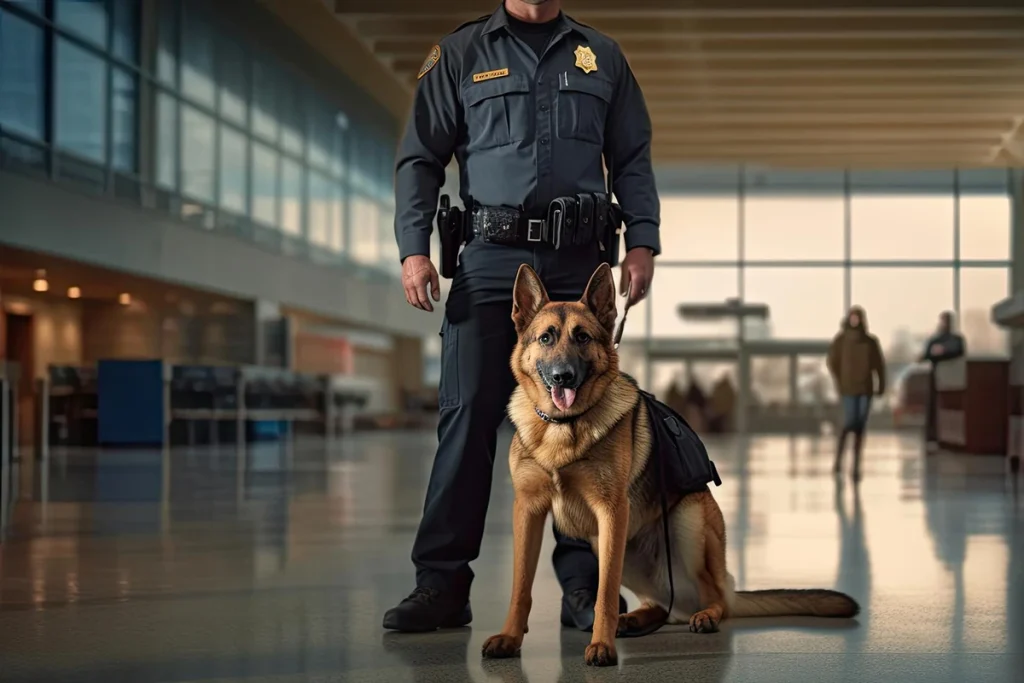
The Guard Dogs Act 1975 is the UK law that controls how guard dogs can be used to protect business premises. In short, a guard dog must either be under the control of a capable handler who is on the premises, or be secured so it cannot roam, and a warning notice must be displayed at every entrance. Breaking these rules is a criminal offence for whoever uses the dog and for anyone who allows it to be used.
This guide explains exactly what the Act requires, where it does and does not apply, the real penalties today (many websites still quote an out-of-date figure), and the other laws that apply to security dogs: the Dangerous Dogs Act 1991, the Animal Welfare Act 2006, civil liability and SIA licensing. It ends with a simple compliance checklist for anyone thinking about using security dogs on their site.
What the Guard Dogs Act 1975 says
The key rules are all in section 1 of the Act. In plain English:
- A handler must be present and in control. You must not use, or allow the use of, a guard dog at any premises unless a handler who is capable of controlling the dog is on the premises and the dog is under their control at all times while it is working.
- The only exception is when the dog is secured. The handler rule does not apply while the dog is secured so that it is “not at liberty to go freely about the premises”, for example in a kennel or a secure run. It also does not apply while another handler has control of the dog.
- A warning notice must be shown at each entrance. You must not use a guard dog at any premises unless a notice warning that a guard dog is present is clearly displayed at each entrance.
The Act defines a guard dog as a dog being used to protect premises, property kept on the premises, or a person guarding the premises or that property. It does not matter what breed the dog is or whether it is a pet at other times. What matters is what it is being used for.
Who can commit the offence?
The wording is “use or permit the use of” a guard dog. That means the offence can be committed by the business that owns or occupies the site, not only by the security company or the handler. If you let a contractor leave a dog loose in your yard overnight with nobody on site, you could be liable too.
Where the Act applies, and where it does not
The Act applies to “premises”, which it defines as land and buildings with two important exclusions:
- Homes. Dwelling-houses and land within the curtilage of a dwelling-house (such as a garden or driveway) are not covered. A dog guarding your house is not a “guard dog” under this Act, although other dog laws still apply.
- Agricultural land. Farmland is excluded.
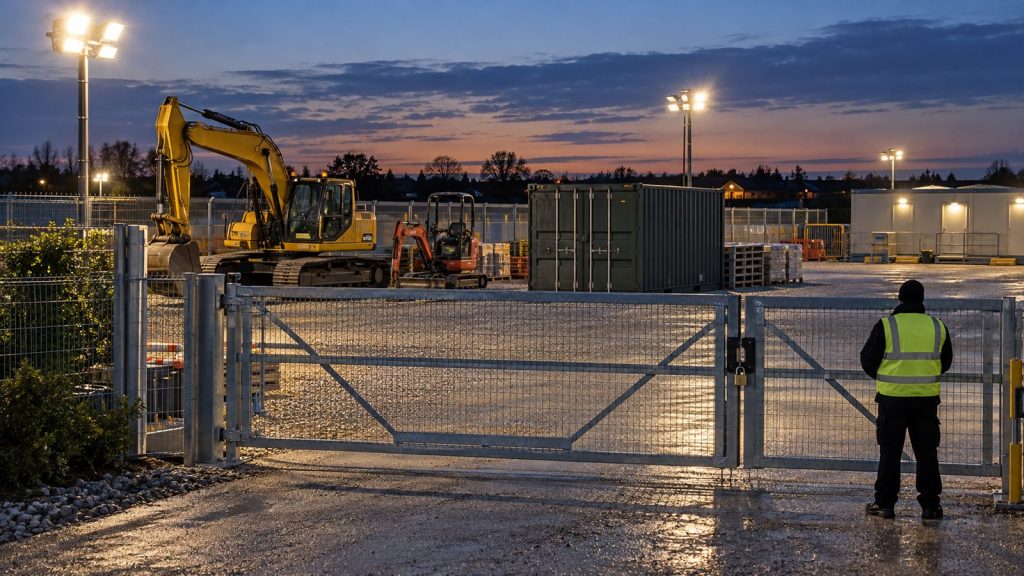
So the Act is aimed squarely at commercial and industrial property: construction sites, warehouses, builders’ merchants, scrapyards, car and HGV yards, factories, vacant buildings and similar sites.
Geographically, the Act covers England, Wales and Scotland. Section 8 states that it does not extend to Northern Ireland, which has its own rules under the Dogs (Northern Ireland) Order 1983. That Order also requires a warning notice at each entrance where a guard dog is used, and guard dog kennels there must be registered with the local council.
What is the penalty for breaking the Guard Dogs Act?
Section 5 makes a breach of section 1 an offence punishable by a fine “not exceeding level 5 on the standard scale”. What that means in pounds depends on where you are:
| Nation | Maximum fine for a Guard Dogs Act offence | Why |
|---|---|---|
| England and Wales | Unlimited | Since 12 March 2015, fines that were capped at £5,000 or more in the magistrates’ court became unlimited (section 85 of the Legal Aid, Sentencing and Punishment of Offenders Act 2012) |
| Scotland | £5,000 | Level 5 on the Scottish standard scale is still £5,000 |
| Northern Ireland | Different law | The Guard Dogs Act does not apply; the Dogs (Northern Ireland) Order 1983 covers warning notices and kennels |
Many security and dog websites still say the fine is “up to £5,000” across the UK. That has not been true in England and Wales for over ten years.
What about guard dog kennel licences?
Sections 2 to 4 of the Act set out a licensing system for guard dog kennels. These sections were never brought into force in Great Britain, and legislation.gov.uk still shows them as “prospective”. So there is currently no Guard Dogs Act licence for kennels or handlers in England, Wales or Scotland. Some websites say handlers need a licence under the Act. They do not, although they do need an SIA licence (see below).
Guard dog warning signs: what the law requires
The law only asks for “a notice containing a warning that a guard dog is present” to be “clearly exhibited at each entrance to the premises”. It does not set a size, colour or exact wording. In practice, a sign that is easy to read in daylight and under site lighting, at every vehicle and pedestrian entrance, is what a court would expect.
Example wording you can adapt:
WARNING: GUARD DOGS ON PATROL
These premises are protected by security dogs working with a trained handler. Do not enter without permission.
Contact: [site or security company phone number]
Practical tips:
- Put a sign at every entrance, including gates that are usually locked and pedestrian gaps in the fence.
- Mount signs at eye level and make sure they are lit or reflective at night.
- Photograph each sign with the date and keep the photos with your site records.
- Replace damaged or stolen signs straight away. A missing sign at one entrance can mean the dog is being used unlawfully.
A sign does not give you permission to break the handler rule, and it does not protect you if a dog that is out of control injures someone.
Other laws that apply to security dogs
The Guard Dogs Act is only one part of the picture. Anyone using security dogs also needs to think about these:
Dangerous Dogs Act 1991
It is an offence for a dog to be dangerously out of control in any place in England or Wales, including private places (Scotland has slightly different rules). GOV.UK explains that a dog is dangerously out of control if it injures someone or makes someone worried that it might injure them. The owner and the person in charge of the dog at the time can both be prosecuted, and the maximum sentences are severe: up to 14 years in prison if a person dies, and up to 5 years if someone is injured.
There is a limited exception for householders when a trespasser is in or entering a home, but it does not cover business premises. This is one more reason why a security dog on a commercial site must always be under a handler’s control or properly secured.
The same Act bans certain types of dog, including the Pit Bull Terrier, Japanese Tosa, Dogo Argentino, Fila Brasileiro and, since 2024 in England, Wales and Scotland, the XL Bully. None of these can be used as a security dog.
Animal Welfare Act 2006
Whoever is responsible for a working dog must meet its welfare needs: a suitable environment, a suitable diet, the chance to behave normally, suitable housing and protection from pain, injury and disease. For security dogs that means proper kennelling, water, rest breaks, safe vehicles with temperature control and vet care. Leaving a dog loose in a yard overnight with nobody on site breaks the Guard Dogs Act and is a welfare risk as well.
Civil liability
The Guard Dogs Act does not create its own right to sue, but it does not remove any other civil claims. In England and Wales, the Animals Act 1971 gives a defence where an animal kept to protect property injures a trespasser, but only if keeping it there for that purpose “was not unreasonable”. A loose, unsupervised dog that breaks the Guard Dogs Act is unlikely to meet that test. Occupiers also owe a duty of care to visitors and, in some situations, to trespassers under the Occupiers’ Liability Acts 1957 and 1984.
Do security dog handlers need an SIA licence?
Yes, when they are guarding premises under a contract. The Security Industry Authority has confirmed that there is no separate “dog handler” licence, but dog handlers are not exempt from licensing. A handler protecting a site against intruders or damage for a client needs the SIA licence that matches their duties, which is usually the security guarding licence.
The main industry standard for security dogs is BS 8517-1:2016, the code of practice for general purpose security dogs. It covers records, kennelling, dog health and welfare, equipment, training and how dogs are used on static sites. It is voluntary rather than law, but it is what professional buyers and insurers expect. The National Association of Security Dog Users (NASDU) promotes training and standards across the sector and publishes its own standard, which builds on BS 8517-1 and BS 8517-2.
Loose dog or handled dog? Quick legal check
| Situation | Guard Dogs Act position | Other risks |
|---|---|---|
| Dog working with a handler who is on site and in control | Allowed | Handler needs an SIA licence; warning signs still needed |
| Dog secured in a kennel or secure run, handler on site or nearby | Allowed while secured | Welfare duties under the Animal Welfare Act |
| Dog loose in a yard overnight, nobody on site | Offence for the user and anyone who permits it | Dangerous Dogs Act and civil claims if someone is hurt |
| No warning notice at one or more entrances | Offence | Weakens any defence if an injury happens |
| Dog guarding a private house or garden | Act does not apply | Dangerous Dogs Act still applies |
| Dog on agricultural land | Act does not apply | Dangerous Dogs Act and livestock laws |
Security dog compliance checklist
Before a security dog works on your site, check that:
- Every handler holds a valid SIA licence for the duties they will carry out.
- A handler will be on the premises whenever the dog is working and not secured.
- A warning notice is clearly displayed at every entrance.
- The dog is not a banned type and its training and health records are available.
- The provider works to BS 8517-1 and can show kennelling, welfare and vehicle arrangements.
- There is a site risk assessment and written assignment instructions covering patrol areas and emergencies.
- The provider’s insurance covers dog handling services.
- Your contract makes clear who is responsible for the dog on your site.
When is a security dog team the right choice?
A handler and dog cover more ground than a single guard and are a strong visible deterrent, which makes them a good fit for large open sites such as construction sites, storage yards, vacant properties and sites with repeated break-ins at night. For reception, access control and busy sites with lots of visitors, a static security guard is usually better. Many larger sites combine both.
FCS Group supplies trained security dogs and handlers for sites across the UK. We are a NASDU associate member. All our security guards are fully SIA licensed and trained. A handler and dog team costs from £24 to £32 per hour outside London and £27 to £36 per hour in London (excluding VAT). See our security guard cost guide for how this compares with other roles, or our construction site security page if you are protecting a building site.
Frequently asked questions
Can I leave a guard dog loose on my business premises?
Only if a handler who can control the dog is on the premises and the dog is under their control, or if the dog is secured so it cannot roam. Leaving a dog loose with nobody on site breaks section 1 of the Guard Dogs Act 1975.
What is the fine for breaking the Guard Dogs Act?
The Act sets a fine of up to level 5 on the standard scale. In England and Wales that has been unlimited since 12 March 2015. In Scotland level 5 is £5,000.
Does the Guard Dogs Act apply to my house?
No. Dwelling-houses, gardens and other land within the curtilage of a home are excluded, as is agricultural land. The Dangerous Dogs Act 1991 still applies to dogs at home.
Do I legally need a guard dog warning sign?
Yes, on any premises covered by the Act. A notice warning that a guard dog is present must be clearly displayed at each entrance. The law does not set the wording or size.
Do security dog handlers need an SIA licence?
There is no separate dog handler licence, but handlers guarding premises under a contract are not exempt. They need the SIA licence that matches their duties, usually the security guarding licence.
Does the Guard Dogs Act apply in Northern Ireland?
No. Northern Ireland has its own rules under the Dogs (Northern Ireland) Order 1983, which also requires a warning notice at each entrance and registration of guard dog kennels with the council.
Summary
The Guard Dogs Act 1975 comes down to three things: a capable handler in control, or the dog secured; a warning sign at every entrance; and responsibility shared by everyone who uses or permits the dog. Add the Dangerous Dogs Act, welfare rules and SIA licensing, and it is clear that security dogs should only be used through a professional, properly licensed provider. If you are considering a dog team for your site, get a free quote and we will advise on the right cover.