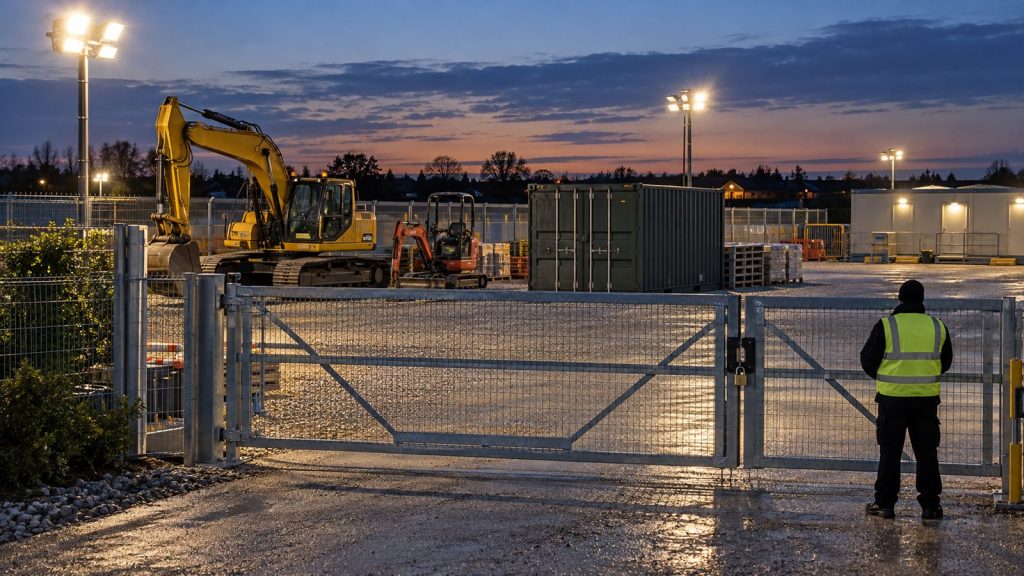

A construction site security checklist is a set of checks that keeps unauthorised people out, protects plant, tools, fuel and materials, and reduces the risk of arson and accidents to trespassers. The most important items are a secure perimeter with signs, one controlled entrance, plant immobilised and locked away every night, a daily close-down routine, fire watch after hot works and a clear plan for out-of-hours cover.
Below you will find the full checklist, organised by when each check happens: before work starts, every evening, every week and at each stage of the build. It is free to use. You can download the one-page printable version for your site office. We also explain what the law actually requires, which figures on construction theft you can rely on, and what to do in the first hour after something is stolen.

Why construction site security matters
Building sites are easy targets. They are often open land, full of valuable plant and materials, empty at night and at weekends, and they change shape every week as the build progresses. Secured by Design estimates that theft, criminal damage, arson and anti-social behaviour cost the construction industry around £800 million a year.
Plant theft is a big part of that. The CESAR scheme describes plant and agricultural machinery theft as an estimated £1 million a week problem, and the police National Construction and Agricultural Theft Team (NCATT) was set up in 2023 to tackle it. The BauWatch Crime Report 2025, which surveyed 3,900 construction professionals across Europe including 500 in the UK, found power tools (52%), copper (48%) and cables (33%) were the items most often stolen.
Security is also about safety. In June 2026 the Health and Safety Executive urged construction companies to strengthen site security, warning that, while rare, children have lost their lives and others have been injured after getting onto unsecured sites.
What the law requires
The Construction (Design and Management) Regulations 2015, known as CDM 2015, include two security duties:
- Regulation 13(4)(b) requires the principal contractor to ensure that “the necessary steps are taken to prevent access by unauthorised persons to the construction site”.
- Regulation 18(2) says that where necessary for health and safety, and in line with the level of risk, a site must, so far as is reasonably practicable, have its perimeter identified by suitable signs so its extent is clear, or be fenced off, or both.
These are health and safety duties, aimed at keeping people (especially children) away from danger, but meeting them also goes a long way to stopping theft. HSE guidance says that in populated areas this will typically mean a two metre high small mesh fence or hoarding around the site. HSE’s guide HSG151, Protecting the public, adds practical points such as naming a person to manage the perimeter, removing ladders from scaffolds out of hours, and immobilising all plant with keys removed.
Fire is covered too. The Joint Code of Practice on fire prevention on construction sites (tenth edition, with Amendment 2 from May 2025) sets out site security against arson and the rules for hot works. If your insurance policy requires you to follow the Joint Code, not doing so could affect your cover.
The construction site security checklist
1. Before work starts (site set-up)
- Carry out a security risk assessment: neighbours, nearby schools, access points, lighting, local crime and previous incidents. The local police Designing Out Crime Officer can often help.
- Put up a continuous perimeter fence or hoarding, around 2 metres high, with no gaps underneath and panels clipped together.
- Fit lockable gates and keep to one controlled entrance for people and vehicles where possible.
- Put signs around the perimeter that make the site boundary clear, with a contact number.
- Name one person responsible for checking and maintaining the perimeter.
- Set up a locked compound or container for plant, tools, fuel, gas cylinders and hazardous substances.
- Keep fuel tanks within the compound, visible, with locking caps and anti-siphon devices.
- Create an asset register with serial numbers, photos, CESAR and tracker details for all plant and high-value tools.
- Plan site lighting for the compound, gates and vulnerable areas.
- Agree the sign-in and induction process, including whether CSCS cards are required on your site.
- Decide on out-of-hours cover: security guards, a security dog team or other measures, based on the risk.
- If security dogs will be used, put a guard dog warning notice at every entrance, as the Guard Dogs Act 1975 requires.
2. Every evening (daily close-down)
- Remove keys from all plant, immobilise machines and lower buckets and forks to the ground.
- Move plant into the compound or park it so it blocks access to other equipment.
- Remove ladders from scaffolds and excavations, or fit locked ladder guards.
- Cover or barrier excavations and make sure materials are stacked safely.
- Lock tools in secure boxes or containers. Do not leave them in vans overnight.
- Lock fuel caps, the fuel store and the hazardous substances store.
- Check that hot works finished in good time and that the fire watch and follow-up checks are complete.
- Check the sign-in sheet so everyone is accounted for.
- Walk the fence line, then chain and lock the gates.
- Hand over to the night guard, if you have one, with any issues from the day.
3. Every week
- Walk the full perimeter and repair any damaged fencing, hoarding or signs.
- Test all security lighting.
- Audit keys and compare plant and tools against the asset register.
- Reconcile fuel use against deliveries to spot fuel theft early.
- Review the incident and near-miss log with your security provider.
- Check the security plan still fits the current stage of the build.
4. By stage of the build
| Stage | Main security risks | Extra checks |
|---|---|---|
| Groundworks | Plant and fuel theft, children getting into excavations | Plant compound, immobilisers, fuel security, excavations covered or fenced |
| Frame and shell | Climbing scaffolds, access through openings, arson | Ladders removed, openings boarded, combustible waste cleared daily |
| Fit-out | Theft of copper, cable, boilers, kitchens and appliances; hot works | Deliveries timed to fitting, lockable rooms, hot work permits and fire watch |
| Handover | Theft of fitted items, trespass or squatting in finished units | Keep guarding until handover, lock and check every unit |
5. Plant and tools
- Register plant with CESAR. Many manufacturers, including JCB, Kubota and John Deere, now fit it as standard. The Construction Equipment Association says CESAR-marked machines are four times less likely to be stolen and six times more likely to be recovered.
- Fit trackers and immobilisers to high-value machines.
- Mark small tools with a company code and keep a tool register.
- Never leave keys in machines or in an unlocked site cabin.
6. Materials and deliveries
- Book deliveries for when they will be used, so materials are not left on site for long.
- Name a person to receive each delivery and check it against the delivery note.
- Never leave deliveries outside the fence, and move high-value items into secure storage the same day.
7. People and access
- Sign everyone in and out, including visitors and delivery drivers.
- Induct every new worker, and escort visitors.
- Use a gatehouse or a single staffed entrance on larger sites.
- Challenge anyone not wearing the right ID or PPE for your site.
8. Fire and arson
- Issue a hot work permit for every hot works job, for a specific place and time.
- Keep a continuous fire watch for at least one hour after hot works finish, then checks at least every 20 minutes for at least a further hour, as the Joint Code of Practice sets out.
- Store combustible materials and waste away from the building and the hoarding.
- Keep fire points, extinguishers and escape routes clear and checked.
9. Out of hours
- Keep gates locked and lighting on.
- Have a contact list for police, the site manager and your security provider.
- On medium and high-risk sites, use on-site cover such as SIA-licensed security guards or a dog handler team at nights and weekends.
How much security does your site need?
Use this simple rating to match your measures to your risk. It is our guidance, not a legal standard.
| Risk level | Typical site | Minimum measures |
|---|---|---|
| Low | Small or rural site, little plant, short programme | Fence and signs, daily close-down, immobilised plant, CESAR |
| Medium | Urban site near homes or schools, plant and fuel on site | All of the above plus lighting, a locked compound, a controlled entrance and out-of-hours security cover |
| High | High-value fit-out, previous incidents, large or phased site, regular hot works | All of the above plus 24/7 SIA-licensed guards and/or a security dog team, a staffed gate and fire watch |
What to do in the first hour after a theft
- Call the police. Dial 999 if the offenders are still on site or anyone is in danger. Otherwise call 101 or report online, and get a crime reference number.
- Keep the scene as it is and keep any footage, sign-in sheets and delivery records.
- Give the police serial numbers and CESAR details for stolen plant, and tell the CESAR/Datatag team. NCATT can be contacted through Northumbria Police.
- Tell the hire company straight away if the equipment is hired.
- Tell your insurer within the time your policy allows.
- Make the site safe again. Repair the fence, lock gates and remove any ladders or hazards the thieves left behind.
- Review your security plan and decide whether you need extra cover, at least for the next few nights.
Security guards and dog teams for construction sites
Fences and locks slow thieves down, but a person on site is what stops them. FCS Group provides construction site security guards for gate control, deliveries and out-of-hours cover, security dog teams for large and open sites, and fire watch officers for hot works. All our security guards are fully SIA licensed and trained.
Construction site guards cost £18 to £24 per hour outside London and £21 to £28 in London, and dog handler teams from £24 to £32 per hour outside London and £27 to £36 in London (excluding VAT). See our security guard cost guide for weekly and monthly examples, and our construction site security guide for a wider look at protecting a building site.
Free printable checklist: download the construction site security checklist (PDF, 1 page). No email or sign-up needed.
Frequently asked questions
Is site security a legal requirement on UK construction sites?
Yes. Under CDM 2015 the principal contractor must take the necessary steps to prevent unauthorised access to the site, and where the risk requires it the site must have its perimeter clearly signed, be fenced off, or both.
Who is responsible for construction site security?
The principal contractor has the main duty to prevent unauthorised access under CDM 2015, working within the arrangements agreed with the client. Contractors are responsible for securing their own plant and tools.
What is stolen most often from construction sites?
In BauWatch’s 2025 survey of construction professionals across Europe and the UK, the most stolen items were power tools (52%), copper (48%) and cables (33%). Plant, fuel and fitted items such as boilers are also common targets.
Does CESAR marking stop plant theft?
It helps a lot. The Construction Equipment Association says CESAR-marked machines are four times less likely to be stolen and six times more likely to be recovered, because they are easier to identify and harder to sell.
Can I use guard dogs on a construction site?
Yes, but under the Guard Dogs Act 1975 a handler must be on site and in control of the dog, unless it is secured so it cannot roam, and a warning notice must be shown at every entrance.
Is a CSCS card a legal requirement?
No. CSCS says holding a card is not a legal requirement and it is up to the principal contractor or client whether to ask for one. Many sites make it a condition of entry.
Building a solar farm? Read our guide to solar farm security during installation.
Worried about stolen machines and tools? Read our guide to construction plant and tool theft.
Summary
Good construction site security comes down to a secure perimeter, one controlled entrance, a strict close-down routine, protected plant and fuel, safe hot works and the right level of out-of-hours cover for your risk. Print the checklist, give it to your site team and review it at every stage of the build. If you need guards, dog teams or fire watch for your site, get a free quote.